
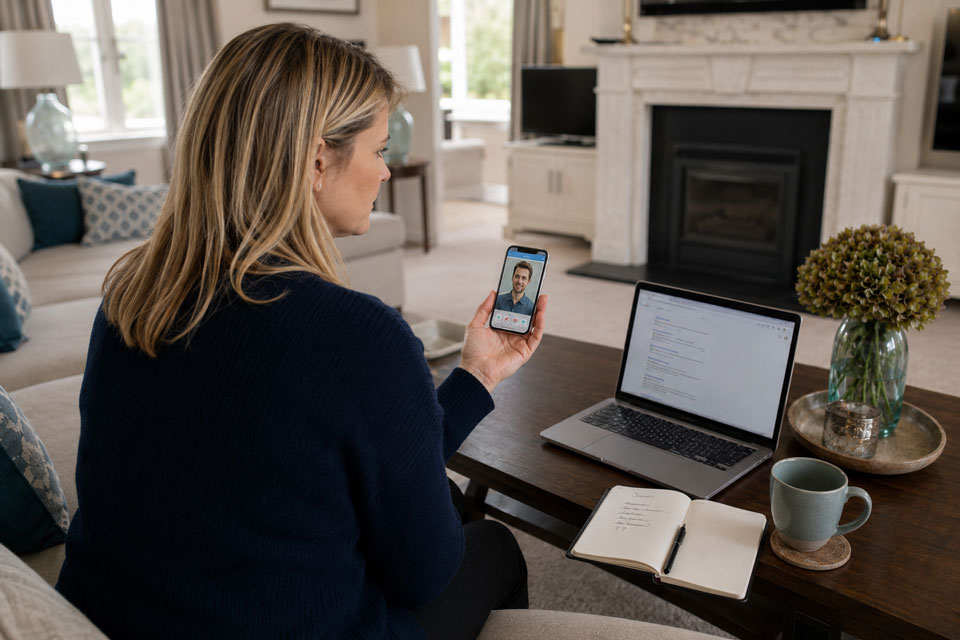
Meeting someone through a dating app, social media platform or online community can lead to a genuine relationship. The difficulty is that, unlike meeting through work, friends or an established social circle, much of what you initially know about that person may come directly from what they have chosen to tell you.
A name, photograph, occupation, home town and relationship history can all appear convincing without having been independently verified. Most people are exactly who they say they are, but when important details begin to conflict, an online dating background check can help establish whether the person behind the profile appears to match the identity and life they have described.
At SPS Investigations, we assist clients who are concerned that somebody they met online may be using a false identity, hiding important information or deliberately misleading them. Our people tracing and identity research services can help cross-check information using lawful sources and proportionate enquiries.
What is an online dating background check?
An online dating background check is an investigation designed to test whether important information provided by an online match can be independently verified.
It is different from simply typing someone’s name into Google. A common name might produce dozens of unrelated people, while somebody deliberately concealing their identity may use a variation of their real name, photographs taken from another account or employment information that sounds plausible but does not withstand closer examination.
A professional investigator looks for connections between different pieces of information. The objective is to determine whether names, photographs, locations, contact details, employment claims and online activity appear to relate consistently to the same individual.
This is also different from a formal employment screening process or DBS check. A private investigator does not have unrestricted access to police databases, confidential government systems or somebody else’s private records simply because a client wants to know more about a person.
What can a dating background check in the UK examine?
The precise scope should depend on what you already know and what has caused concern. A proportionate investigation might examine:
- Identity details: whether the name, approximate age, location, telephone number, email address and other identifiers appear to relate to the same person.
- Photographs: whether profile photographs appear elsewhere online, are associated with another name or seem inconsistent with the identity being presented.
- Employment and business claims: whether publicly verifiable information supports claims about a company, directorship, business ownership or professional background.
- Publicly available online profiles: whether older or parallel accounts reveal conflicting names, locations, occupations or personal circumstances.
- Address and location connections: where relevant and lawful, whether available information is consistent with the area in which the person claims to live.
- Relationship or family information: whether publicly available material raises legitimate questions about an undisclosed partner or domestic situation.
- The person’s overall timeline: whether the different parts of their story fit together when dates, locations and claims are compared.
The value often comes from combining several sources rather than relying on one search result. A single matching name proves very little. Several independent identifiers pointing towards the same individual can provide a much stronger basis for an identity match.
Can a private investigator verify someone’s real identity?
In many cases, this is the most important starting point.
Some clients approach us knowing a full name, telephone number, email address, approximate age, occupation and general location. Others have been speaking to somebody for months but still possess surprisingly little information that can be independently checked.
Our people tracing work can involve comparing the details supplied by the client with lawful databases, open-source information and other relevant records. The aim is to determine whether the information consistently identifies one person rather than simply finding somebody online with a similar name.
Identity verification is particularly important before investigating other claims. If somebody has provided a false surname, incorrect age or misleading location, searching for information using those details can lead to the wrong person and unreliable conclusions.
Can profile photographs help verify an online date?
Yes. Photographs can provide useful investigative leads, particularly in suspected catfishing cases.
Open-source image research may establish that the same photograph appears elsewhere on the internet under another name. An image might originate from a genuine person’s social media account, a professional website, an old dating profile or another publicly accessible source.
That does not automatically prove fraud. Photographs can be reposted, copied without permission or appear on legitimate accounts belonging to the same person. Investigators therefore need to consider the image alongside other identifiers rather than treating one visual match as conclusive.
The increasing availability of convincing digitally altered and AI-generated images also makes it particularly important to look beyond the photograph itself. The stronger question is whether the photograph, name, location, employment history, contact details and wider online footprint all fit together.
Can employment claims be checked?
Sometimes, although there are important limitations.
If someone claims to own a limited company or be a company director, the Companies House public register may provide useful information. Companies House makes public company information available free of charge, including information about current and former officers, company status and filing history.[3]
However, a Companies House search is not a general employment database. Most employees will not appear simply because they work for a business. Equally, appearing as a director does not prove every other claim the person has made about their career.
Professional profiles, company websites, published biographies, historic web pages and other open sources can sometimes provide additional context. Any information should still be cross-checked because online profiles can be outdated, exaggerated or created by the person being investigated.
Dating profile verification is not the same as a background check
Many people assume that because an account has passed a dating platform’s verification process, everything written on the profile must be accurate.
Those are two different questions. What a verification badge confirms depends on the particular platform and the process it uses. It should not automatically be treated as independent verification of somebody’s employment, home circumstances, relationship status, financial position or wider personal history.
An online dating identity check looks beyond the dating profile and asks whether important information can be corroborated through independent and lawful sources.
What is catfishing?
Catfishing generally describes somebody presenting a false or substantially misleading identity online, often using another person’s photographs or invented biographical information.
The motive is not always financial. Somebody may create a false persona for attention, emotional manipulation, secrecy or other personal reasons. In more serious cases, however, the false identity can form part of a deliberate fraud.
A person might claim to have a prestigious occupation, live in a particular part of London, be temporarily working overseas or have access to significant money. Those claims can gradually be used to create credibility before an apparent emergency, investment opportunity or request for financial assistance appears.
Romance fraud remains a serious problem in the UK
Romance fraud goes considerably further than somebody exaggerating their height, age or job on a dating profile.
It typically involves building trust and an emotional relationship before manipulating the victim into transferring money. City of London Police reported that 10,784 reports of romance fraud were made during 2025, an increase of 29% compared with 2024.[1]
Victims lost more than £102 million. The average individual loss was approximately £9,500, while some reported losses reached as much as £1 million.[1]
The figures are particularly relevant to our clients in London. The Metropolitan Police Service area recorded £12.1 million in romance fraud losses during the same period, the highest total recorded by any police force area in the figures published by City of London Police.[1]
Under the Fraud Act 2006, dishonestly making a false representation with the intention of making a gain or causing another person loss can constitute fraud by false representation.[4] Whether a particular situation amounts to a criminal offence will depend on the facts and is ultimately a matter for the police, prosecutors and courts rather than a private investigator.
Warning signs that may justify verifying an online date
No single behaviour proves that somebody is using a false identity. There can be innocent explanations for unusual online behaviour. Concerns become more significant when several inconsistencies repeatedly appear together.
- Their surname, age, job or location changes or becomes difficult to explain.
- They refuse video calls or repeatedly prevent you from seeing them clearly in real time.
- Photographs appear unusually professional, inconsistent in age or disconnected from the rest of their online presence.
- They claim to have a prominent career or business but you can find no credible supporting information.
- They are reluctant to introduce you to friends, relatives or anybody from their wider life after the relationship becomes established.
- Stories about where they live, where they work or why they are unavailable frequently change.
- They quickly introduce financial problems, investments, loans, cryptocurrency, business opportunities or requests for money.
- They discourage you from discussing the relationship with friends or relatives who might question their story.
Again, these are reasons to ask questions, not proof of wrongdoing. A proper investigation should test the information objectively rather than begin from the assumption that deception must have occurred.
What about someone who may already have a partner?
A false identity and a hidden relationship sometimes overlap. Someone may use their genuine first name and photographs while lying about where they live, whether they are single or how much of their personal life they are revealing.
We have covered this particular issue separately in our guide, Is the Person You Met Online Already Married?, including the limitations of marriage records and the circumstances in which other proportionate enquiries may be appropriate.
For a broader online dating background check, the first question is usually more fundamental: have we established that this person is actually who they claim to be?
How does a private investigator verify an online date?
A sensible investigation begins with the information already available rather than immediately trying to uncover more.
We may ask the client to provide the dating profile, recent photographs, the name being used, approximate age, telephone number, email address, claimed occupation and the town or part of London where the person says they live. Messages can also provide useful context where the client is lawfully entitled to possess them, particularly if they contain specific factual claims that need to be checked.
From there, the investigation can be narrowed to particular questions. For example, is this person’s identity genuine? Is the business they claim to own real? Does the photograph belong to somebody else? Are there multiple profiles using different names? Do several independent pieces of information connect the individual to a different location?
This approach is more reliable and proportionate than attempting to compile an unlimited dossier about somebody’s private life.
Anonmyised Case Study: Online Relationship Investigation Uncovers False Identity
A client based overseas contacted SPS Investigations after becoming concerned about a long-distance relationship with a man claiming to live in the UK. He presented himself as wealthy, provided a name, age and place of birth, and claimed that his family owned a high-value property. However, inconsistencies began to emerge in the personal information he supplied, including conflicting dates of birth. The client became particularly concerned when he began requesting payments via cryptocurrency and wanted his identity verified before travelling to the UK to meet him.
SPS Investigations carried out extensive identity enquiries, including searches using variations of the supplied name, partial-name searches, different age ranges and birth dates, and checks for links to the locations he had claimed. No credible record could be found matching the identity provided, and enquiries also established that he had no recorded connection to the high-value property he claimed was associated with his family. The investigation concluded that the identity details supplied to the client were fictional, raising serious concerns that the false information had been used as part of an attempt to obtain money or assets by deception.
Are online dating background checks legal in England?
They can be, but the investigation must comply with data protection and other applicable laws.
Private investigators processing personal information are subject to the UK GDPR and Data Protection Act 2018, as amended by the Data (Use and Access) Act 2025. Most of the remaining principal data protection provisions introduced by the 2025 Act came into force in February 2026.[5]
The Information Commissioner’s Office has also approved a specialist UK GDPR Code of Conduct for Investigative and Litigation Support Services. It covers matters including lawful bases, legitimate interests assessments, tracing, background investigations and other investigative processing.[6]
Where legitimate interests is the appropriate lawful basis, ICO guidance requires consideration of the purpose of processing, whether using the information is necessary for that purpose and whether the individual’s interests, rights and freedoms override the interests being pursued.[7]
In practical terms, an investigator should have a specific objective, use information relevant to that objective and avoid unnecessarily intrusive enquiries.
A background check cannot guarantee that someone is trustworthy
This is one of the most important limitations to understand.
A thorough search might confirm that the person’s name, approximate age, employment and other information appear genuine. That does not guarantee that they have been truthful about every aspect of their life or that they will behave honestly in the future.
Equally, finding very little information about someone does not automatically mean that they are hiding something. Some people maintain almost no public social media presence, do not run companies, have common names or deliberately keep their personal information offline for perfectly legitimate reasons.
Professional investigation is therefore about evidence and confidence levels rather than absolute guarantees. Where information cannot be verified, that should be reported as unresolved rather than converted into a conclusion that the person must be lying.
What should you do if you think you are being targeted by romance fraud?
If somebody you met online has started requesting money, encouraging investments or asking you to transfer funds for an emergency, the priority should be preventing further financial loss rather than conducting an extended private investigation.
If money has already been transferred, contact your bank or payment provider promptly and preserve relevant messages, payment information, profile details and other evidence. Fraud and cyber crime in England, Wales and Northern Ireland can now be reported through Report Fraud. The service replaced Action Fraud in December 2025.[2]
A private investigation may still assist with establishing identity or preserving relevant factual information, but it should not delay reporting suspected criminal activity.
How SPS Investigations can help verify someone you met online
If a relationship has become serious but important information still does not add up, we can assess what you currently know and explain what may realistically be verified.
At SPS Investigations, we are based in London and provide private investigation services throughout London and the Home Counties. Our people tracing services can be particularly useful where the first challenge is establishing somebody’s genuine identity from limited information.
We may be able to cross-check names, photographs, contact details, locations, employment or business information and other relevant details using lawful research and proportionate investigative enquiries. Where information conflicts, we focus on identifying what can actually be evidenced rather than making assumptions about the reason for the discrepancy.
For somebody worried about catfishing, romance fraud, a fabricated background or a person who appears to be maintaining more than one identity, establishing the basic facts early can prevent months of uncertainty and may help you make a more informed decision about the relationship.
If you are concerned about somebody you met through a dating app or online, contact SPS Investigations for a confidential discussion. We can explain which aspects may be capable of verification, what information would be useful to begin with and the limitations of any proposed investigation.
Online Dating Background Check FAQs
Can a private investigator do an online dating background check in the UK?
Yes, a private investigator may be able to verify relevant information about someone you met online where there is a lawful purpose for the investigation and the enquiries are necessary and proportionate. This can include identity research, public records, open-source information and other lawful investigative resources.
How can I verify someone I met on a dating app?
Verification usually involves comparing several identifiers rather than relying on one search. A full name, recent photograph, approximate age, telephone number, email address, claimed occupation and location can provide useful starting information for an investigator.
Can a private investigator find someone’s real name from a dating profile?
Potentially. The likelihood of identifying the correct person depends on how much genuine information is available. Photographs, telephone numbers, email addresses, usernames, locations and other identifiers may help establish a reliable identity match, but successful identification cannot be guaranteed.
Can you check whether a dating profile photo is fake?
Investigators can carry out open-source image research to determine whether a photograph appears elsewhere online or is associated with another identity. A matching image should still be assessed alongside other evidence because photographs can be copied or reused without the original person’s knowledge.
Can a private investigator check where my online date works?
Sometimes. Public company information, professional profiles, company websites and other lawful sources may help test an employment or business claim. There is no general public database listing everybody’s employer, so some employment claims may remain impossible to independently confirm.
Can a private investigator check whether somebody has a criminal record?
There is no general right for a private investigator to search police databases or obtain somebody’s confidential DBS information for a dating enquiry. Criminal offence data is specially protected under UK data protection law. Relevant information that is already lawfully public may sometimes be considered where justified, but it must still be processed lawfully and accurately.
Is it legal to background check someone without telling them?
It can be lawful in some circumstances, but there is no blanket exemption simply because the information is being collected by a private investigator. The investigator must identify an appropriate lawful basis for processing personal information and consider necessity, proportionality and the individual’s rights.
Can a background check tell me if somebody is married?
It may identify relevant information, but establishing current relationship status can require different enquiries from a general identity check. We explain this in more detail in our guide, Is the Person You Met Online Already Married?.
What information should I give a private investigator about my online date?
Useful starting information can include the person’s dating profile, name, recent photographs, telephone number, email address, approximate age, claimed job, social media usernames and the area where they say they live. You should provide information you already possess lawfully rather than attempting to access their private accounts or devices.
What should I do if an online date has asked me for money?
Requests for money from somebody known mainly through an online relationship should be treated cautiously, particularly where the request involves emergencies, investments, cryptocurrency or repeated promises that the money will soon be repaid. If you believe you have been defrauded, contact your bank or payment provider promptly and report the matter to Report Fraud.
References and Sources
1) City of London Police – Romance fraud costs UK victims £102 million in a year as reports surge by nearly a third:
https://www.cityoflondon.police.uk/news/city-of-london/news/2026/may/romance-fraud-costs-uk-victims-102-million-in-a-year-as-reports-surge-by-nearly-a-third/
2) GOV.UK – Report Fraud: New service from City of London Police:
https://www.gov.uk/government/news/report-fraud-new-service-from-city-of-london-police
3) Companies House – Searching the Companies House register:
https://www.gov.uk/guidance/searching-the-companies-house-register
4) Legislation.gov.uk – Fraud Act 2006, Section 2:
https://www.legislation.gov.uk/ukpga/2006/35/section/2
5) Information Commissioner’s Office – The Data (Use and Access) Act 2025: What does it mean for organisations?:
https://ico.org.uk/about-the-ico/what-we-do/legislation-we-cover/data-use-and-access-act-2025/the-data-use-and-access-act-2025-what-does-it-mean-for-organisations/
6) Information Commissioner’s Office – Association of British Investigators UK GDPR Code of Conduct for Investigative & Litigation Support Services:
https://ico.org.uk/for-organisations/advice-and-services/codes-of-conduct/register-of-uk-gdpr-codes-of-conduct/the-association-of-british-investigators-limited-uk-gdpr-code-of-conduct-for-investigative-litigation-support-services/
7) Information Commissioner’s Office – What is the legitimate interests basis?:
https://ico.org.uk/for-organisations/uk-gdpr-guidance-and-resources/lawful-basis/legitimate-interests/what-is-the-legitimate-interests-basis/
8) Legislation.gov.uk – Computer Misuse Act 1990, Section 1:
https://www.legislation.gov.uk/ukpga/1990/18/section/1
9) Legislation.gov.uk – Data Protection Act 2018, Section 170:
https://www.legislation.gov.uk/ukpga/2018/12/section/170
10) Information Commissioner’s Office – Criminal offence data:
https://ico.org.uk/for-organisations/uk-gdpr-guidance-and-resources/lawful-basis/a-guide-to-lawful-basis/criminal-offence-data/