
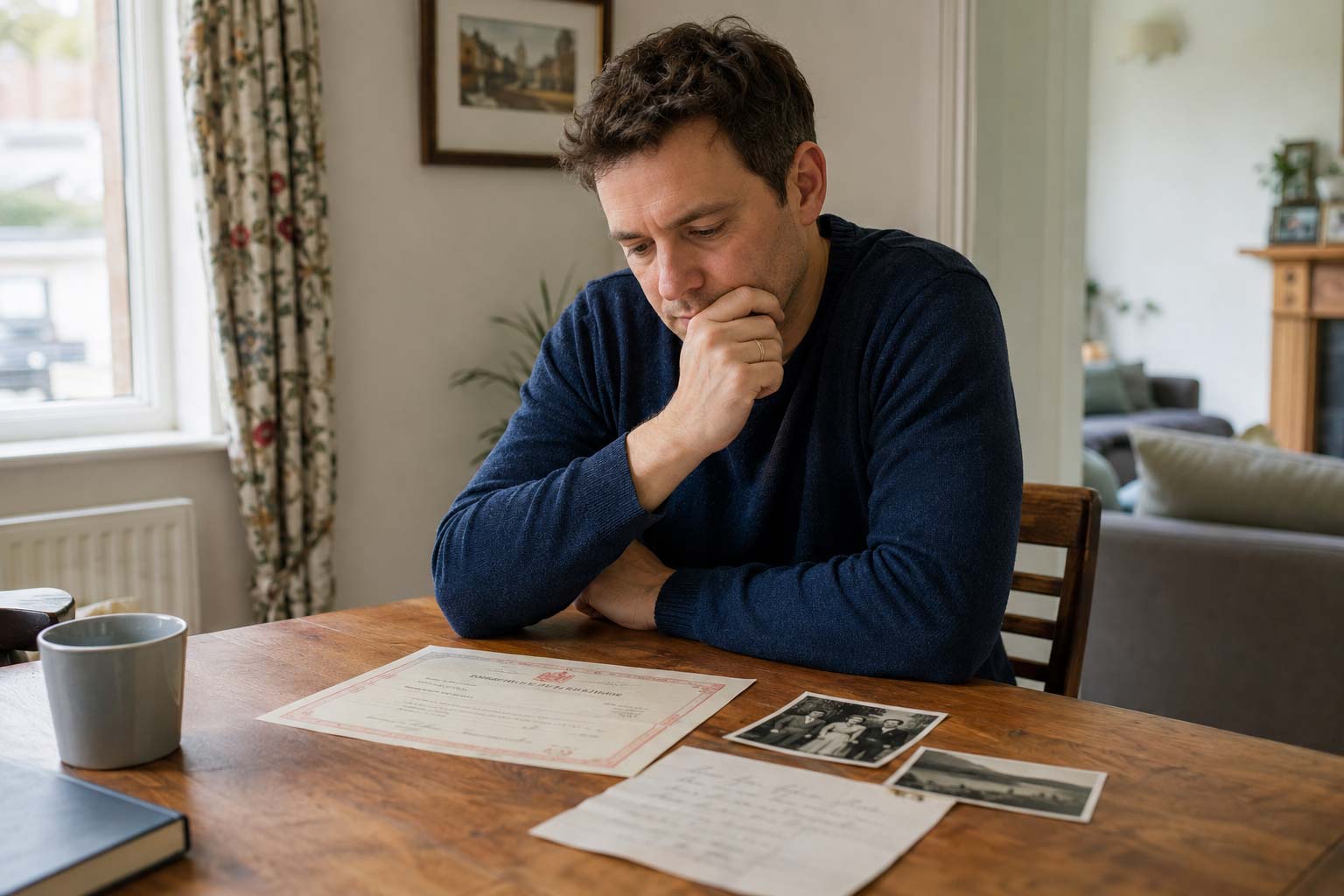
Trying to find a parent you have never met can feel very different from searching for a relative you once knew. You may have no memories of them, no recent photograph and no previous address. Sometimes all you have is a name written on a birth certificate, a rough idea of their age, an occupation they had decades ago or the name of a town where they once lived.
That may seem like very little information to work with, but it can still provide the beginning of a trace. The challenge is not simply finding someone with the right name. It is establishing, as reliably as possible, that the person identified is actually the biological mother or father you are looking for.
At SPS Investigations, we provide people tracing services for clients across London and the Home Counties. We regularly work with limited or historic information and use lawful, proportionate research to narrow possible matches before any contact is considered.
Where do you start when looking for a parent you have never met?
The first stage is usually to separate what you know from what you have been told or assumed. Family information can change as stories are passed from one person to another, particularly when several decades have passed.
Write down every detail you currently have, even if you are unsure whether it is completely accurate. Useful information can include:
- A full or partial name, including possible middle names.
- An approximate age or year of birth.
- A name appearing on your birth certificate.
- A former town, neighbourhood or address.
- An occupation, employer or type of work.
- Names of relatives, friends or other people connected to them.
- Old photographs, letters, cards or documents that may contain additional clues.
A detail does not necessarily need to be current to be useful. Knowing that somebody worked as an electrician in Croydon in the late 1980s, for example, may help distinguish them from several people with the same name once that information is combined with an approximate age and other family details.
Can you find a parent from a birth certificate?
A birth certificate can be one of the most valuable starting documents when trying to find a biological parent in the UK. Depending on the circumstances of the registration, it may provide a parent’s full name, an address, occupation or other information that helps establish their identity.
The General Register Office holds civil registration records for England and Wales, including births, marriages, civil partnerships and deaths. These records can be useful for researching family connections and changes that occurred later in somebody’s life.[1]
However, the information on a certificate should normally be treated as the beginning of the investigation rather than the final answer. Someone may have moved repeatedly, married, divorced, changed surname, changed career or left the area entirely.
There is another important distinction. Tracing the person named as a parent and proving a biological relationship are not necessarily the same thing. A trace can help identify and locate an individual, but it does not provide genetic proof of parentage. If biological paternity or maternity is genuinely disputed, separate DNA testing or legal advice may be required.
How can you trace a birth father who is not on your birth certificate?
Finding a birth father can be considerably more difficult when no father is named on the birth certificate, but it is not necessarily impossible.
The search may instead begin by reconstructing the circumstances around the time of your birth. You may have been told his first name, approximate age, occupation, workplace, where he lived, where your mother met him or the area in which he spent time.
Individually, each clue may be too broad. Together, they can become much more useful.
For example, a first name alone may produce hundreds of possibilities. If that person was believed to be approximately 25 years old, worked in a particular profession and lived in a specific part of London during a known period, the number of credible possibilities may reduce substantially.
This is where careful identity matching becomes particularly important. An investigator should not approach somebody merely because they appear to fit one or two details. The available information should be cross-checked and competing possibilities eliminated as far as reasonably possible first.
What if you are trying to trace your birth mother?
A birth mother’s identity may initially appear easier to establish because her name will normally be closely connected with the birth record. The difficulty can arise when trying to follow what happened afterwards.
She may have married and changed surname, subsequently divorced, remarried or moved several times. A surname that was correct when you were born may therefore have little connection with the name she uses today.
This is one reason why a trace should follow a person’s identity through time rather than simply searching the internet for their original name. Marriage records, historic addresses, known relatives and other lawful sources may help connect an earlier identity to a more recent one.
Why are common names difficult to trace?
One of the biggest difficulties when trying to find a parent you never met is what investigators sometimes face in any identity-matching exercise: there may be several people who appear to fit.
Imagine you are trying to trace a man with a very common name and you believe he was born somewhere between 1960 and 1965. Finding ten people with the same name is not progress unless there is a reliable way of determining which one, if any, is connected to you.
Useful identifiers become especially important in these cases. A middle name, previous area, occupation, known sibling, former partner or historic address can help eliminate false matches.
It is also important to allow for inaccuracies. If a relative remembers that your father was 30 when you were born, he may actually have been 27 or 34. A town remembered as Watford may have been somewhere nearby in Hertfordshire. An occupation may describe an industry rather than the person’s actual job title.
A professional trace therefore needs to test the information rather than treating every starting detail as unquestionably correct.
How does a private investigator narrow down possible parents?
When we undertake a people trace at SPS Investigations, our aim is not to produce the first person who seems plausible. We work towards a sufficiently strong identity match by comparing multiple pieces of information.
Depending on the circumstances and lawful basis for the instruction, research may include public records, open-source material, lawful professional databases, historic address information and connections between names, locations and other identifiers.
The process often involves eliminating candidates as much as finding them. Someone may have the correct name but be ten years too young. Another person may have lived in the correct town but have no connection with any of the other information supplied. A third person may match the approximate age, occupation, area and relevant family connections.
The more independent details that point towards the same individual, the stronger the identification becomes.
Old information is not necessarily useless
People sometimes assume that information from 20, 30 or 40 years ago cannot help locate somebody today. In practice, historic information can be extremely important because it provides a fixed point from which a person’s later history can sometimes be reconstructed.
A former address might connect somebody to a spouse. A workplace may confirm that two people with similar names are different individuals. A marriage may explain why somebody disappeared from searches under their original surname.
What matters is not simply how old the information is, but whether it can be connected reliably to other information.
Can social media help you find a biological parent?
Sometimes. Search engines and social media can provide useful clues, particularly where somebody has an unusual name, distinctive occupation or clear connection to a particular area.
However, social media is also a common source of mistaken identity. A photograph that appears to resemble another family member is not reliable evidence by itself. Ages may be hidden or inaccurate, locations can be out of date and many people use shortened names or keep their profiles private.
It is therefore sensible to avoid sending an emotional message to somebody simply because an online profile looks promising. If the person is not your parent, that approach may cause unnecessary distress or confusion. If they are your parent, the first contact is still something that deserves careful thought.
What can a private investigator legally do when tracing a parent?
People tracing involves processing personal information and must be conducted within the UK’s data protection framework. This includes the UK GDPR and Data Protection Act 2018, as subsequently amended, including by the Data (Use and Access) Act 2025.[4][6]
The Information Commissioner’s Office explains that where legitimate interests is relied upon as a lawful basis, organisations must consider the purpose of the processing, whether the use of personal information is necessary and whether the individual’s interests, rights and freedoms override that interest.[3]
The ICO also maintains an approved UK GDPR code of conduct for investigative and litigation support services, reflecting the particular data protection considerations that arise within professional investigation work.[5]
At SPS Investigations, we use lawful and proportionate research methods. A private investigator cannot simply obtain somebody’s confidential medical information, bank records, private telephone records or protected government information because a client wants to find a parent. Nor can an investigator lawfully hack into private email or social media accounts.
The fact that somebody is technically capable of obtaining information does not make obtaining or using it lawful.
Will a private investigator give you your parent’s home address?
Not automatically.
There is an important difference between establishing that somebody has been located and deciding what information should then be disclosed. In a sensitive family-reconnection case, handing over a private residential address may not be the most appropriate outcome.
The purpose of the search, data protection considerations, potential safeguarding issues and the circumstances of the people involved all need to be considered.
In some cases, an intermediary approach may be more suitable. This can allow the parent to be approached discreetly and told that their adult son or daughter would like to make contact. They can then decide whether they are comfortable responding or sharing contact details.
For somebody who has spent many years wondering about a parent they have never met, this can feel slower than simply receiving an address. However, it can provide a much more respectful way of beginning what may be an important and emotionally complicated conversation.
Tracing a parent is different if you were adopted
If you were adopted, there is an important legal distinction between conducting an ordinary people trace and obtaining information through the adoption-record system.
In England and Wales, GOV.UK explains that an adopted person aged 18 or over can access their birth records. Where an adopted person knows their birth details, they can apply for their original birth certificate through the General Register Office. Different procedures apply where those details are not known, and people adopted before 12 November 1975 who do not know their birth details must attend a counselling session with an approved adoption adviser before accessing them.[2]
There are also regulated intermediary services for certain adoption cases. GOV.UK states that intermediary agencies can help trace birth relatives in qualifying cases and that, where a person is found through that process, contact can only take place if they agree.[7]
This means that someone trying to find a biological parent following adoption should not assume that hiring a private investigator replaces the official adoption-record process.
If adoption is involved, it may be necessary to obtain information through the General Register Office, the relevant adoption service or an approved intermediary route first. Once the correct lawful route and available information are established, it can then be considered whether any separate tracing assistance is appropriate.
What happens once your parent has been found?
Finding somebody can answer one question but immediately create several new ones.
You may have imagined the first conversation for years. The parent may have no idea that you are searching for them. They may have another family who know nothing about the circumstances surrounding your birth. They may be pleased to hear from you, need time to process the information or decide that they do not want contact.
There is no way of guaranteeing the response.
For this reason, the initial approach should usually be neutral and respectful rather than arriving unexpectedly at someone’s home or contacting numerous members of their family through social media.
If a person clearly says that they do not want further contact, that decision needs to be respected. Repeated unwanted approaches can potentially engage the Protection from Harassment Act 1997 in England and Wales.[8]
What should you expect emotionally from a parent trace?
Searching for a biological mother or father can carry expectations that do not exist in many other forms of people tracing.
Some people want a relationship. Others want answers about where they came from, what their parent looks like or why there was no contact. Some mainly want medical or family-history information. Others are unsure what they want until the person is actually found.
It can therefore help to think about the possible outcomes before beginning the search.
Finding somebody does not guarantee a reunion, and a successful trace should not be measured only by whether a close relationship develops afterwards. Sometimes the result is simply knowing that the correct person has been identified and giving both sides the opportunity to decide whether contact should follow.
How SPS Investigations can help you find a biological parent
At SPS Investigations, we understand that trying to locate a parent you have never met can be a deeply personal instruction. You may be starting with very little information and may not know which details are useful.
We can review the information you already have, identify which details may help narrow the search and carry out lawful enquiries designed to establish the correct individual rather than relying on an unverified match.
We provide professional people tracing services from London and assist clients throughout London and the Home Counties. We have a proven track record of tracing people and helping clients re-establish contact with relatives after long periods apart.
Where a trace involves sensitive family circumstances, we can also discuss how the result should be handled and whether a more cautious approach to contact would be appropriate.
If you would like to discuss tracing a birth mother, birth father or another parent you have never met, get in touch with SPS Investigations for a confidential discussion about the information you currently have and the options available.
Frequently Asked Questions
Can a private investigator find a parent I have never met?
Potentially, yes. A private investigator may be able to trace a biological parent using lawful records, professional databases, historic information and open-source research. The chances of success depend on how much reliable identifying information is available.
Can you find a biological parent with only their name?
Sometimes, particularly if the name is unusual. A common name is much harder to trace without other information. An approximate age, former town, occupation, middle name or known family connection can significantly improve the ability to identify the correct person.
Can I trace my birth father if he is not named on my birth certificate?
It may still be possible. Information such as his first name, approximate age, former location, occupation, employer or details about when and where he knew your mother can provide useful starting points. However, limited information can make verification considerably more difficult.
Can I trace my birth mother if she has changed her surname?
Potentially. Marriage records, previous addresses, known relatives and other lawful sources can sometimes connect a former surname with a person’s current identity.
Does finding someone prove they are my biological parent?
No. A people trace can establish that an individual matches the identifying information supplied, but it does not provide genetic proof of parentage. Where biological parentage is uncertain or disputed, separate DNA testing or legal advice may be appropriate.
Will a private investigator tell me where my parent lives?
Not automatically. In sensitive family cases, privacy, safeguarding and data protection considerations may mean that an intermediary approach is more appropriate than disclosing a private home address.
What if I was adopted and want to find my birth parents?
Adopted adults in England and Wales have specific routes for accessing birth and adoption information. The General Register Office and regulated adoption intermediary services may need to be used, depending on the circumstances. A private trace should not be treated as a substitute for the statutory adoption-record process.
Is it legal to trace a biological parent in the UK?
People tracing can be carried out lawfully, but the methods and purpose of the search matter. Investigators processing personal information must comply with applicable data protection and privacy law and cannot unlawfully access confidential records or private online accounts.
How long does it take to find a parent you have never met?
There is no standard timescale. A distinctive full name combined with an approximate age and former address may produce a clearer route than a search involving a common first name, uncertain age and no confirmed location. Historic surname changes and overseas moves can also make tracing more complex.
Final thoughts
If you are trying to find a parent you have never met, do not assume that having limited information means the search cannot go any further. A name on a birth certificate, approximate age, former town or occupation can sometimes provide enough information to begin building a much clearer picture.
The important part is verification. Finding somebody with the correct name is relatively easy. Establishing that they are genuinely the birth mother or birth father you are looking for can require several independent pieces of information to align.
Once the correct person has been identified, contact should be handled with the same care as the search itself. The aim should be to create an appropriate opportunity for contact rather than assuming that locating somebody automatically gives another person access to their private life.
If you have limited information about a biological parent and would like to understand whether a professional trace may be possible, contact SPS Investigations to discuss your circumstances confidentially.
References
1) GOV.UK – Research your family history using the General Register Office:
https://www.gov.uk/research-family-history
2) GOV.UK – Adoption records: Accessing your birth records:
https://www.gov.uk/adoption-records
3) Information Commissioner’s Office – Legitimate interests:
https://ico.org.uk/for-organisations/uk-gdpr-guidance-and-resources/lawful-basis/a-guide-to-lawful-basis/legitimate-interests/
4) UK Legislation – Data Protection Act 2018:
https://www.legislation.gov.uk/ukpga/2018/12/contents
5) Information Commissioner’s Office – The Association of British Investigators UK GDPR Code of Conduct for Investigative & Litigation Support Services:
https://ico.org.uk/for-organisations/advice-and-services/codes-of-conduct/register-of-uk-gdpr-codes-of-conduct/the-association-of-british-investigators-limited-uk-gdpr-code-of-conduct-for-investigative-litigation-support-services/
6) UK Legislation – Data (Use and Access) Act 2025:
https://www.legislation.gov.uk/ukpga/2025/18/contents
7) GOV.UK – Adoption records: Intermediary agencies:
https://www.gov.uk/adoption-records/intermediary-agencies
8) UK Legislation – Protection from Harassment Act 1997, Section 1:
https://www.legislation.gov.uk/ukpga/1997/40/section/1