
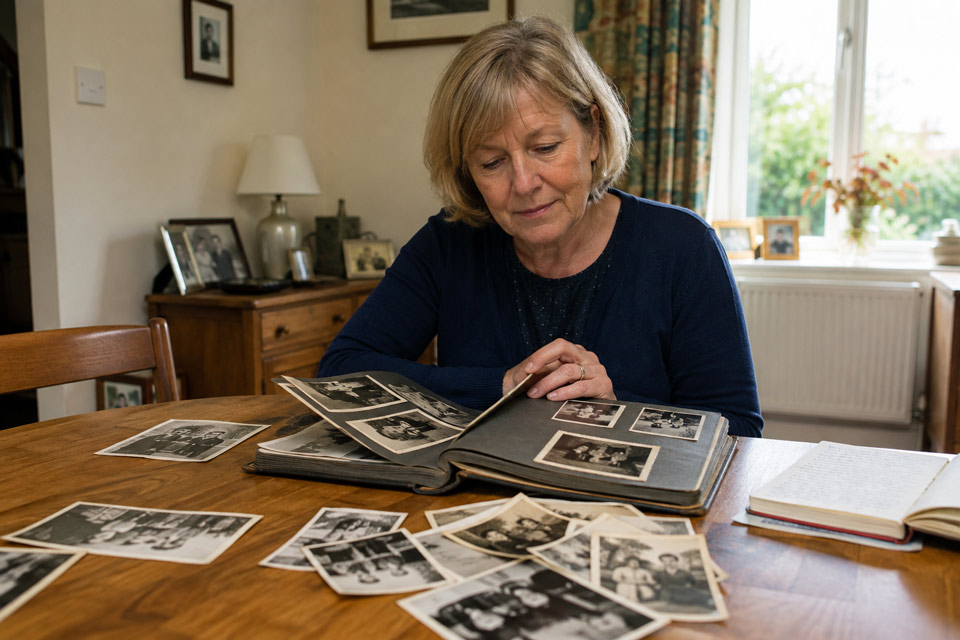
Losing contact with a relative can happen gradually or suddenly. A disagreement may divide a family, somebody may move away and lose touch, or years can pass without anyone knowing exactly where a sibling, cousin, aunt, uncle or other relative now lives.
For some people, the decision to find an estranged relative comes after a bereavement or another major life event. Others want to understand their family history, pass on important information, reconnect before more time passes, or simply find out whether a relative is well.
Finding somebody is only one part of the process. In sensitive family cases, the way contact is made afterwards can be just as important. An estranged relative may welcome the opportunity to reconnect, but they may also want time to consider what they want to do. This is why family tracing should be approached carefully rather than treating a person’s address as information that should automatically be handed over.
At SPS Investigations, we provide people tracing services for clients across London and the Home Counties. We have experience tracing people in personal, legal and corporate enquiries, including cases where relatives have been out of contact for many years.
Why do people try to find estranged family members?
There is rarely a single reason for wanting to find an estranged relative. Sometimes there has been a deliberate separation. In other cases, families have simply drifted apart following house moves, marriages, divorces or changes in circumstances.
Common reasons for beginning a family trace include:
- Wanting to rebuild a relationship with a sibling, cousin, aunt, uncle, grandparent or other relative.
- A bereavement or serious family event prompting somebody to restore contact.
- Trying to complete gaps in a family history or family tree.
- Wanting to pass on important family or medical information.
- Finding relatives after family branches became separated through relocation, marriage or divorce.
- Needing to contact somebody regarding an estate, inheritance or other family matter.
The reason for the search matters because it may affect how information can appropriately be gathered and what should happen once the person has been located.
Start by writing down everything you already know
If you are wondering how to find estranged relatives in the UK, it can be tempting to begin by entering their name into a search engine or social media platform. Before doing that, it is often more useful to collect everything you already know into one place.
A professional family trace is ultimately an identity-matching exercise. Finding someone with the same name is not enough. The objective is to establish whether the information belongs to the correct person and to rule out other possible matches.
Useful starting information can include:
- Their full name, including middle names, maiden names, married names and previous surnames.
- An approximate age or date of birth.
- Their last known address, town or area.
- Names of parents, siblings, partners, children or other relatives.
- Previous employers, occupations, schools or universities.
- Old telephone numbers and email addresses.
- Previous social media accounts or usernames.
- Copies of old letters, photographs, certificates or other documents containing useful identifying information.
- Any known moves within the UK or overseas.
Even information that appears outdated can be valuable. A twenty-year-old address may establish a connection to another relative, previous surname or area that helps distinguish the correct person from somebody with a similar name.
If your starting information is particularly limited, we have also written a separate guide explaining whether somebody can be traced with only a name in the UK.
Search family records before looking for a current address
Sometimes the quickest route to an estranged relative is not to search directly for their present address. Instead, it can help to reconstruct what happened to that branch of the family.
The General Register Office holds records of births, marriages, civil partnerships and deaths registered in England and Wales. Its records can be valuable when researching family relationships, marriages and changes of surname. GRO records for England and Wales date back to July 1837, although the periods searchable through particular online indexes vary.[1]
Marriage records can be particularly useful where somebody may have changed their surname. Death records can also prevent a search continuing on the incorrect assumption that a relative is still alive.
Where a deceased family member may connect different branches of a family, probate records can sometimes provide another useful line of research. The government’s probate search service allows people to search probate records for England and Wales and, where available, order copies of wills and grants.[3]
These records do not necessarily reveal where a living estranged relative is today, but they may help establish relationships and identify names that can take the search forward.
Speak to relatives who may remember more than you expect
Family knowledge is frequently fragmented. One person may remember an old address while another remembers a married surname, place of work or the town somebody moved to.
If it is appropriate to do so, speaking to trusted relatives can therefore produce information that would be difficult to discover from records alone. Old Christmas cards, address books, wedding photographs, funeral notices and family correspondence can also contain useful clues.
It is worth distinguishing facts from assumptions. For example, being told that somebody “moved to Manchester” many years ago is useful, but it should not be treated as confirmation that they still live there. The same applies to remembered workplaces, relationships and surnames.
Can you use the electoral register to find a lost relative?
The electoral register is sometimes mentioned when people discuss family tracing, but there is an important distinction between the full electoral register and the open register.
The open register is an extract that can be bought by individuals, businesses and organisations. People can choose to opt out of appearing on it. The full electoral register contains wider information but its use is legally restricted to specified purposes.[2]
This means an electoral-register search should not be treated as a complete database of everyone living in the UK. Somebody may be absent from the open register even though they are registered to vote, and information found in historical records may no longer be current.
Searching online for an estranged relative
Search engines and social media can sometimes help locate a lost relative, particularly where you have an unusual name, occupation or known location. However, online searches can also produce convincing but incorrect matches.
A relative may use a married surname, shortened name or middle name. They may have deleted old accounts, made profiles private or have very little online presence. Somebody with a common name can produce hundreds or thousands of possible results.
When searching publicly available information, look for several details that support the same identity rather than relying on a photograph or name alone. A combination of age, previous location, occupation and known family connections is considerably stronger than a single matching detail.
Why estranged relatives can be difficult to find
Finding estranged family members becomes harder as time passes. People move home, change telephone numbers and email addresses, marry, divorce and change surnames. Older relatives may have little or no social media presence, while younger relatives may use usernames that bear no obvious connection to their legal name.
Family memories can also be inaccurate. An age may be a few years out, a surname may be spelt differently or somebody may remember the wrong town. A person believed to have moved overseas may subsequently have returned to the UK.
This is why professional family tracing generally involves building and verifying a chain of information rather than relying upon one database or search result.
How can a private investigator help find an estranged relative?
When your own searches stop producing reliable results, a private investigator may be able to develop the information further.
At SPS Investigations, we begin by understanding who you are trying to locate, your relationship to them and why you want to make contact. We then assess the information already available and whether there is an appropriate and lawful basis for us to undertake the trace.
Depending on the circumstances, our enquiries may involve lawful professional databases, address-history research, public records, open-source research and cross-checking connections between names, addresses and other identifiers. Our objective is not simply to find somebody who appears to match. We work to establish that the person located is actually the relative our client is looking for.
We cannot access private bank records, medical files, confidential government systems, private telephone records or protected online accounts simply because somebody wants to find a relative. Private investigators do not have special legal powers that allow them to bypass normal privacy and data protection rules.
Does a private investigator have to give you the relative’s address?
No. Finding an address does not automatically mean that it is appropriate to disclose that address to the person who commissioned the trace.
This distinction is especially important in personal family-reconnection cases. Data protection law requires organisations processing personal information to have an appropriate lawful basis and to consider necessity, proportionality and the rights and interests of the individual concerned. The ICO’s current guidance explains that legitimate interests involves considering the purpose of processing, whether it is necessary and whether the individual’s interests, rights and freedoms override that interest.[4]
The ICO-approved UK GDPR code of conduct for investigative and litigation support services also specifically addresses consent to share information when tracing and locating individuals in certain circumstances.[5]
A family trace is therefore different from certain legal, estate or litigation instructions where a verified address may be necessary for a clearly defined legal purpose.
An intermediary approach can be better for sensitive family tracing
In an estranged-family case, an intermediary process can sometimes provide a better balance between the person searching for their relative and the privacy of the person who has been found.
Instead of immediately giving the searching relative a residential address, an investigator may be able to approach the person located and explain that somebody wishes to make contact. The person can then decide whether they are comfortable communicating directly or having their contact information passed on.
This can reduce the risk of an unexpected visit to somebody’s home and gives the located person a degree of control over what happens next.
The first contact should normally be calm and neutral. There may be family circumstances the searching person does not know about, and it can be unhelpful to assume that the relative will immediately welcome renewed contact.
What happens if your relative wants to reconnect?
If the relative is happy to resume contact, it is often sensible to allow the relationship to develop at a pace that works for both sides.
After many years apart, the first conversation does not need to resolve every issue that caused the estrangement. A telephone call, email or exchange of messages may feel more comfortable than an unexpected face-to-face meeting.
There may also be other family members affected by renewed contact. Giving everybody time to process the situation can make a successful reconnection more likely than trying to recreate a close relationship immediately.
What if an estranged relative does not want contact?
There is also a possibility that the person you locate will not want to resume contact. That can be difficult to hear, particularly after investing considerable time and emotion in finding them.
However, locating somebody does not create an entitlement to a relationship with them. If a relative clearly states that they do not want contact, that choice should be respected.
Repeated unwanted approaches can also create legal problems. The Protection from Harassment Act 1997 prohibits a course of conduct amounting to harassment where the person responsible knows or ought to know that it amounts to harassment.[8]
A sensitive intermediary approach can therefore provide clarity without placing either party in an uncomfortable position.
Finding relatives to share important medical information
Medical information can sometimes prompt people to locate estranged family members. A hereditary condition may have been identified, for example, or somebody may want to ask relatives about conditions that have appeared elsewhere in the family.
A family trace can potentially help establish a route through which relatives can communicate, but it does not give an investigator authority to obtain somebody else’s confidential medical records.
Health information receives additional protection under UK data protection law because data concerning health is classed as special category personal data.[6] If medical information is one of your reasons for finding somebody, the appropriate aim may therefore be to establish contact so that information can be shared voluntarily rather than trying to obtain confidential records about them.
Family tracing and UK data protection law
Professional people tracing involves the processing of personal information and must be carried out within the UK’s data protection framework, including the UK GDPR and Data Protection Act 2018 as subsequently amended, including by the Data (Use and Access) Act 2025.[7]
The existence of information online or within a database does not mean that it can automatically be collected, used or disclosed for any purpose. Investigators must consider the purpose of the instruction, how intrusive the proposed research would be and what effect disclosure could have upon the person being traced.
Similarly, knowing or guessing somebody’s password does not provide lawful permission to access their email, social media, cloud storage or other private accounts. Unauthorised access to computer material can engage the Computer Misuse Act 1990.[9]
At SPS Investigations, we use lawful and proportionate methods. We do not hack accounts, impersonate people to obtain confidential records or unlawfully access protected medical, banking, telephone or government information.
What if the person is missing rather than simply estranged?
There is an important difference between looking for a relative you have lost contact with and believing somebody may currently be missing or in danger.
If you believe a relative is at immediate risk, vulnerable or genuinely missing in circumstances that cause concern for their safety, the police should be contacted rather than waiting for a private family trace. A private investigator should not be treated as a substitute for an urgent safeguarding or missing-person response.
How long does it take to locate a lost relative?
There is no standard timescale for family tracing. Someone with a distinctive name, recent previous address and several reliable identifiers may be considerably easier to locate than somebody who disappeared from family contact thirty years ago.
A trace may also require more work where the relative has changed surname, moved several times, lived overseas, has a common name or has deliberately kept their personal information private.
The quality of the information available at the beginning of the search can therefore make a significant difference.
How we can help you trace an estranged relative
At SPS Investigations, we understand that family tracing is often very different from locating somebody for a commercial or legal matter. There can be years of personal history behind a request, and finding the person is not necessarily the end of the process.
We provide discreet people tracing services from London, assisting clients throughout London and the Home Counties. We have a proven track record of tracing people in personal, family, legal and corporate-related enquiries.
We can review the information you already have, explain whether a trace appears realistic and discuss an appropriate way of handling the result. Where privacy or family sensitivities make direct disclosure inappropriate, an intermediary approach may be considered.
If you would like to discuss finding an estranged sibling, cousin, aunt, uncle or another family member, get in touch with us for a confidential conversation about your circumstances.
Frequently Asked Questions
Can a private investigator find an estranged family member in the UK?
Potentially, yes. A private investigator may be able to trace an estranged relative using lawful records, professional databases, open-source information and other proportionate enquiries. The likelihood of success depends on the information available and how long the person has been out of contact.
How do I find an estranged relative if I only know their name?
A name can provide a starting point, but additional information such as an approximate age, previous address, former surname or known family connection can make the search considerably more reliable. Common names are particularly difficult to trace without other identifiers.
Can you find a sibling who has changed their surname?
It may still be possible. Marriage records, historic addresses, family connections and other identifying information can sometimes establish a link between a previous surname and a current identity.
Will a private investigator give me my relative’s home address?
Not automatically. In sensitive family-reconnection cases, privacy, safeguarding and data protection considerations may mean that an intermediary approach is more appropriate. The relative may be contacted first and asked whether they are willing for their details to be shared.
Is it legal to find an estranged family member in the UK?
People tracing can be carried out lawfully, but the purpose and methods used matter. Professional investigators must comply with applicable data protection, privacy and other laws and cannot unlawfully access private accounts, confidential records or restricted databases.
What happens if my relative does not want to speak to me?
Their decision should be respected. A successful trace establishes where or how somebody may be contacted, but it does not give another person a right to force renewed contact. Repeated unwanted contact may become inappropriate and potentially amount to harassment.
Can I find an estranged relative because of important medical information?
A family trace may help establish contact so medical or hereditary information can be discussed directly. However, a private investigator cannot simply access another person’s confidential medical records, and health information receives additional protection under data protection law.
How long does family tracing take?
It varies considerably. Recent and detailed information can make a trace relatively straightforward, while searches involving common names, surname changes, historic addresses or decades without contact may require more extensive research and verification.
What should I do if I think my relative is missing or in danger?
If you are concerned that somebody is currently missing, vulnerable or at immediate risk, contact the police. Call 999 where there is an immediate danger. A private family trace should not delay an urgent safeguarding response.
Final thoughts
If you are trying to work out how to find estranged family in the UK, the most useful first step is often to gather what you already know and establish a clear picture of the person you are looking for.
Public records, family knowledge and open-source research can sometimes take the search a long way. When they do not, professional family tracing can help connect historic information with a person’s present circumstances and verify that the correct individual has been located.
Just as importantly, finding an estranged relative should be handled with consideration for their privacy and wishes. In many family cases, the best outcome is not simply receiving an address. It is creating a safe and appropriate opportunity for contact to be offered and allowing the person found to decide what happens next.
References
1) GOV.UK – Research your family history using the General Register Office:
https://www.gov.uk/research-family-history
2) GOV.UK – The electoral register and the ‘open register’:
https://www.gov.uk/electoral-register/opt-out-of-the-open-register
3) GOV.UK – Search probate records for documents and wills:
https://www.gov.uk/search-will-probate
4) Information Commissioner’s Office – Legitimate interests:
https://ico.org.uk/for-organisations/uk-gdpr-guidance-and-resources/lawful-basis/a-guide-to-lawful-basis/legitimate-interests/
5) Information Commissioner’s Office – The Association of British Investigators UK GDPR Code of Conduct for Investigative & Litigation Support Services:
https://ico.org.uk/for-organisations/advice-and-services/codes-of-conduct/register-of-uk-gdpr-codes-of-conduct/the-association-of-british-investigators-limited-uk-gdpr-code-of-conduct-for-investigative-litigation-support-services/
6) Information Commissioner’s Office – Special category data:
https://ico.org.uk/for-organisations/uk-gdpr-guidance-and-resources/lawful-basis/a-guide-to-lawful-basis/special-category-data/
7) UK Legislation – Data (Use and Access) Act 2025:
https://www.legislation.gov.uk/ukpga/2025/18/contents
8) UK Legislation – Protection from Harassment Act 1997, Section 1:
https://www.legislation.gov.uk/ukpga/1997/40/section/1
9) UK Legislation – Computer Misuse Act 1990:
https://www.legislation.gov.uk/ukpga/1990/18/contents