
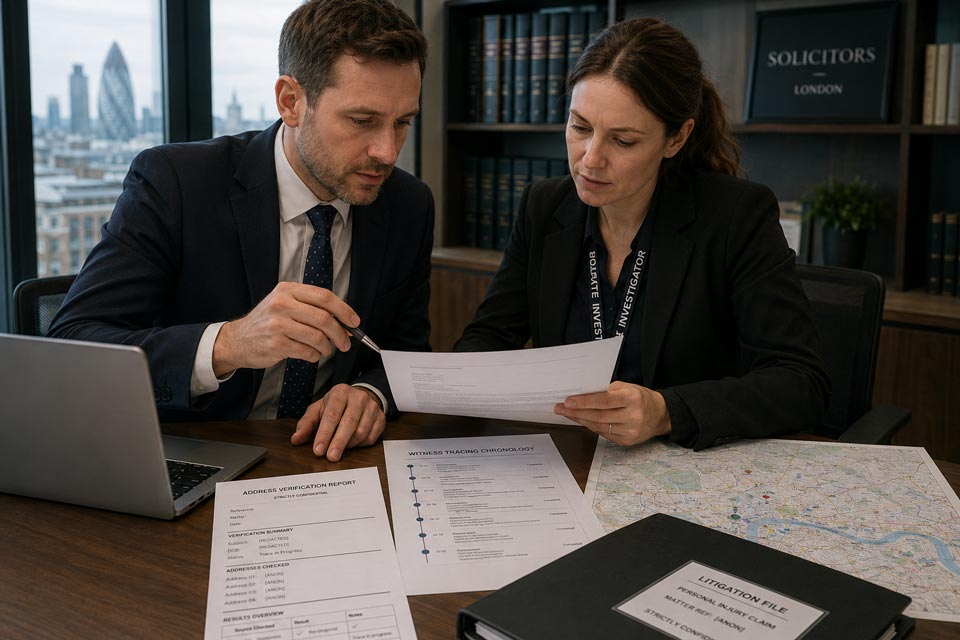
Solicitors frequently need information that cannot be obtained from the case papers alone. A witness may have moved without leaving an obvious forwarding address. A defendant may no longer live at the address stated in a contract. A beneficiary may have lost contact with the family, or an individual may be avoiding correspondence and attempts at service.
In these situations, a private investigator can provide practical support by locating people, verifying information and documenting the steps taken. The investigator does not replace the solicitor, decide the legal strategy or determine whether evidence should be relied upon. Their role is to establish facts and report them clearly so that the solicitor can make an informed decision about the proceedings.
At SPS Investigations, we provide private investigation and litigation support services for solicitors, businesses and private clients across London and the Home Counties. We have previously been instructed by leading law firms and understand the importance of confidentiality, accurate reporting, secure communication and carefully defined investigative objectives.
What Does Litigation Support From a Private Investigator Involve?
Litigation support is a broad term covering investigative work carried out before proceedings begin or while a case is progressing. Although surveillance may be appropriate in some cases, much of the work is research-based and focused on identifying, locating and verifying people or addresses.
A private investigator may support a solicitor by:
- Tracing missing or unresponsive witnesses
- Locating defendants, debtors, beneficiaries and other interested parties
- Confirming whether an individual is connected to a current address
- Making lawful and discreet factual enquiries
- Serving court papers and other legal documents
- Providing structured reports, statements and records of attendance
The most appropriate service depends on the legal issue, the information already available and the objective identified by the solicitor. A tightly defined instruction is generally more productive than an open-ended request to investigate everything that might be connected to a person.
Why Witness Tracing Can Be Crucial to a Legal Case
A witness can be important because they saw an event, attended a meeting, dealt with a disputed transaction or have first-hand knowledge of a relevant conversation. Their evidence may help confirm a chronology, explain a document or resolve an inconsistency between the parties’ accounts.
However, witnesses are not always easy to find. Proceedings may begin several years after the relevant events. During that time, a witness may have changed address, surname, telephone number, employer or online profile. The solicitor may only have a historic business address or an email account that is no longer active.
A professional witness trace is intended to do more than identify somebody with a similar name. The objective is to establish, as far as reasonably possible, that the person located is the correct individual and that the address or contact information is sufficiently current to support the solicitor’s next step.
This may involve reviewing information provided by the instructing solicitor, examining historic address and employment connections, conducting open-source research and checking professional data sources that are lawfully available for investigative use. Possible matches should be cross-checked rather than reported as confirmed simply because a name appears in a search result.
Our separate guide on tracing someone with only a name explains why additional identifiers, such as an approximate age, former address, employer, telephone number or known associate, can significantly improve the reliability of a trace.
Anonymised Case Study: Locating an Important Witness for a Solicitor
In one successful instruction, we were contacted by a solicitor who needed to locate an important witness connected to an ongoing matter. The solicitor had already attempted to find the individual but the information available through routine enquiries was no longer current.
The witness had a potentially important connection to the events being considered. However, the available details were limited and there was a risk of confusing the witness with another person who had a similar identity.
We began by reviewing the identifiers and historic information supplied by the solicitor. We then examined relevant address, professional and personal connections using lawful research methods and appropriate investigative data sources. Potential matches were assessed against the known chronology so that outdated or unrelated records could be eliminated.
After cross-checking the available information, we successfully located and verified a current address for the witness. We provided the solicitor with a structured report explaining the information relied upon, the verification steps taken and any limitations that remained.
This allowed the solicitor to decide how the witness should be approached and what procedural steps, if any, were required next. The investigation did not determine what the witness would say, whether they would cooperate or how the court would assess their evidence. It resolved the immediate problem of locating the correct person and gave the solicitor a reliable basis for progressing the matter.
The identity of the solicitor, witness and parties remains confidential. Details have been generalised to protect everyone involved.
Locating Defendants, Beneficiaries and Other Relevant People
Witnesses are not the only people who may need to be traced during legal proceedings. Solicitors may also require assistance locating a defendant, former tenant, debtor, company director, beneficiary, executor, family member or individual connected to disputed property.
Each trace should have a clear and legitimate purpose. For example, a solicitor may need to establish a defendant’s current address before sending pre-action correspondence, confirm the whereabouts of a beneficiary during estate administration or identify the correct individual after a business has ceased trading.
A trace should not be treated as a guarantee that an individual will respond, accept liability or cooperate with the proceedings. It provides verified information that may enable the solicitor to take the next appropriate legal or procedural step.
Confirming an Address Before Legal Documents Are Served
An address appearing on an old agreement, invoice or Companies House filing may no longer be current. Sending important correspondence to an outdated address can cause delay, increase costs and create uncertainty about whether the intended recipient received the documents.
Address confirmation can therefore be a valuable step before process serving. Depending on the circumstances, an investigator may examine recent address links, occupancy indicators, professional connections and other lawful information to assess whether the individual remains associated with the address.
The Civil Procedure Rules contain detailed provisions governing the service of claim forms and other documents, including the permitted methods of service, personal service, service at an address and certificates of service.[4] Family proceedings are governed by separate service rules, including provisions covering personal service and who may serve particular documents.[5]
The correct approach depends on the document, proceedings, court order and information available. A private investigator should therefore work to the solicitor’s instructions rather than assume that the same method is suitable for every case.
Process Serving and Documented Attempts at Service
Once an address has been identified, a process server may be instructed to deliver the relevant documents. The process server’s role is to identify the correct recipient, follow the applicable service requirements and provide a clear record of what happened.
A process server does not have general enforcement powers. They cannot force entry, seize property, threaten the recipient or pretend to be a bailiff, police officer or court official. Their authority is limited to carrying out the service instruction lawfully and accurately recording the outcome.
A report of service may record the date, time and location of the attendance, how the recipient was identified, what documents were delivered and any relevant words or conduct. Where service is unsuccessful, the report can document each attempt and the circumstances encountered. This information may help the solicitor consider a further attendance, additional tracing or an application concerning an alternative method of service.
At SPS Investigations, we provide process serving across London and the Home Counties. We can combine tracing, address verification and service where a recipient’s whereabouts are uncertain, while keeping each stage of the instruction clearly documented.
Can a Private Investigator Approach a Witness?
A private investigator may be asked to make a professional approach to a witness after the correct person has been located. Any contact should be carefully planned with the instructing solicitor, particularly where proceedings are active or the witness may be vulnerable, reluctant or connected to another party.
The investigator should not intimidate, pressure or coach the witness. A witness is not required to provide information simply because a private investigator has contacted them. The investigator should accurately explain their role and avoid making misleading statements about the case or their authority.
Where a witness is willing to engage, the investigator may record a factual account or obtain relevant information in the format agreed with the solicitor. The solicitor can then decide whether a formal witness statement should be prepared and how it should be used.
In civil proceedings, Part 32 of the Civil Procedure Rules governs witness evidence and the use of witness statements.[1] Practice Direction 32 sets out requirements relating to the form and content of statements, including how information and belief should be identified and how statements are verified.[2]
Family proceedings have their own rules. Under Part 22 of the Family Procedure Rules, a witness statement is a signed written statement containing evidence that the person would be allowed to give orally, and the court may give directions about service and attendance at the final hearing.[6]
Locating a Witness Does Not Compel Them to Cooperate
There is an important difference between finding a witness and compelling their participation. A private investigator has no power to require a witness to answer questions, provide documents or attend a hearing.
Where a witness’s attendance or production of documents is required in civil proceedings, the solicitor may need to consider the court procedure for obtaining and serving a witness summons. Part 34 of the Civil Procedure Rules governs witness summonses and related requirements.[3]
The investigator’s task may be to establish where the witness can be contacted or where a summons may potentially be served. Decisions about whether a summons should be sought and the procedural requirements involved remain matters for the solicitor and court.
Obtaining Factual Statements Without Influencing the Evidence
Where an investigator is asked to speak to a witness, the interview should be directed towards establishing the witness’s own recollection. Leading the person towards a preferred version of events can undermine the reliability of the account and create difficulties if the evidence is later challenged.
A professional interviewer should distinguish between what the witness personally saw or heard, what they inferred and what they were subsequently told by somebody else. Dates, uncertainty and gaps in memory should be recorded honestly rather than filled with assumptions.
The investigator should also avoid promising confidentiality that cannot be guaranteed. A statement or interview note created for litigation may become relevant to disclosure or evidential decisions. The instructing solicitor should determine how the material is handled and whether a formal statement is required.
Why Structured Investigation Reports Matter
A solicitor needs to understand not only the conclusion of an investigation, but how that conclusion was reached. A report that merely states that an address is “confirmed” provides little assistance if it does not explain the information used to verify it.
A well-structured litigation support report may include:
- The instruction received and the objective of the investigation
- The identifying information supplied at the outset
- The searches, enquiries and attendances completed
- The dates and times of material investigative steps
- Any conflicting information, limitations or unresolved uncertainty
- Relevant supporting documents, photographs or exhibits
Reports should separate confirmed facts from reasonable assessment and clearly label information supplied by a third party. Unsuccessful searches can also be relevant because they show what was attempted and prevent later duplication of work.
An investigator may subsequently be asked to provide their own witness statement describing the steps they took, an attendance they made or the circumstances in which documents were served. Careful records make it easier to prepare that statement accurately if it becomes necessary.
Our guide to whether private investigator evidence is admissible in court explains why relevance, authenticity, reporting quality, preservation and procedural compliance may all affect how investigative material is treated.
Confidentiality and Secure Communication With Law Firms
Litigation support instructions can contain highly sensitive information, including names, addresses, family relationships, allegations, medical information, financial circumstances and details of ongoing proceedings.
Solicitors regulated by the Solicitors Regulation Authority are required to keep the affairs of current and former clients confidential unless disclosure is required or permitted by law or the client consents.[12] An investigator receiving information from a law firm must also handle it securely and only for the agreed purpose.
At SPS Investigations, we understand that confidentiality must extend beyond avoiding public disclosure. It includes controlling who has access to the instruction, verifying recipients before sending reports, limiting information to what is relevant and agreeing an appropriate communication method with the instructing firm.
We can work with a nominated solicitor or case handler, use agreed reference numbers and structure updates according to the firm’s requirements. Where the matter is especially sensitive, the reporting and communication arrangements should be agreed before investigative work starts.
Data Protection and Lawful Witness Tracing
Witness tracing and litigation support usually involve the processing of personal information. An investigator must identify an appropriate lawful basis and comply with the wider data protection principles, including purpose limitation, data minimisation, accuracy, storage limitation and security.
Legitimate interests may be relevant to some tracing and litigation support instructions, but it is not automatic. The purpose must be legitimate, the processing must be necessary and the investigator must consider whether the individual’s interests, rights and freedoms override the interest being pursued.[7]
Additional requirements may apply where the investigation involves special category data or information relating to alleged criminal conduct. The Data Protection Act 2018 and UK GDPR must also be read with the amendments introduced by the Data (Use and Access) Act 2025.[10][11]
In November 2024, the Information Commissioner’s Office approved the first sector-owned UK GDPR code of conduct for investigative and litigation support services.[8] The code addresses sector-specific issues such as tracing, invisible processing, lawful bases, data protection impact assessments, data security and the respective responsibilities of investigators and clients.[9]
Lawful tracing does not include hacking accounts, accessing private communications, bypassing passwords or obtaining protected records through an unauthorised route. Unauthorised access to computer material may constitute an offence under the Computer Misuse Act 1990.[13]
When Should a Solicitor Instruct a Private Investigator?
An investigator is often most useful when instructed before a procedural deadline becomes urgent. Early involvement allows time to assess the available identifiers, conduct proportionate searches, verify a result and make further enquiries if the first lead is outdated.
However, the instruction should still be focused. The solicitor should explain who needs to be found, why they are relevant, what information is already known and what outcome is required. It is also helpful to identify any court dates, limitation concerns, service deadlines or restrictions affecting contact with the individual.
A clear brief helps the investigator avoid unnecessary enquiries and produce a report that fits the solicitor’s intended use. It can also help establish an appropriate budget and realistic expectation of what can be achieved.
How SPS Investigations Supports Solicitors
We work with solicitors on witness tracing, address confirmation, process serving, factual enquiries and other litigation support assignments. We have previously been instructed by leading law firms and understand that professional clients require more than a possible address or informal update.
Our approach is to establish the purpose of the instruction, review the information already available and agree the expected reporting format. We then use lawful and proportionate methods to pursue the defined objective.
Where a trace is successful, we explain the basis on which the person or address has been identified. Where the available evidence remains uncertain, we say so rather than presenting a possible match as a confirmed result. Reports can be structured around the solicitor’s requirements and supported by attendance records or other relevant material where appropriate.
Based in London, we provide private investigation services across the capital and the Home Counties. To discuss a witness trace, address verification, process-serving instruction or another form of solicitor-led litigation support, please get in touch with SPS Investigations.
Frequently Asked Questions
Can a private investigator trace a witness in the UK?
Yes. A private investigator may be able to trace a witness using information supplied by the solicitor, open-source research, lawful professional databases and identity verification. The prospects of success usually improve when the investigator has a full name, approximate age, previous address, employer or another reliable identifier.
Can SPS Investigations trace a witness with only a name?
Sometimes, although a name alone may produce several possible matches. A distinctive full name may be enough in some cases, while a common name will usually require additional information such as an approximate age, previous location, telephone number, employer or known relative.
Can a private investigator contact a witness directly?
A private investigator can make a professional approach where this forms part of a lawful and properly planned instruction. Contact should be non-coercive and coordinated with the solicitor. The investigator cannot compel the witness to answer questions or provide a statement.
Can a private investigator take a witness statement?
An investigator can obtain a voluntary factual account and may assist with recording what a witness says. Where the statement is intended for court proceedings, the instructing solicitor should ensure that it complies with the relevant procedural rules, statement-of-truth requirements and case directions.
Can a private investigator force a witness to attend court?
No. A private investigator has no power to compel attendance. In civil proceedings, a solicitor may consider applying for a witness summons under Part 34 of the Civil Procedure Rules. The court process and service requirements must then be followed.
Can an investigator confirm an address before documents are served?
Yes. Address verification may help establish whether a defendant, witness or other relevant person remains connected to a suspected address. The result can help the solicitor decide where and how service should be attempted under the rules applying to the proceedings.
Can SPS Investigations serve court documents?
Yes. We provide process-serving services across London and the Home Counties. We can record the date, time, location, method and outcome of each attendance, with the reporting format agreed according to the document and the solicitor’s requirements.
Is an investigator’s report automatically accepted by the court?
No. An investigator’s report may be useful evidence, but acceptance and weight are not automatic. The court may consider relevance, reliability, authenticity, lawfulness, disclosure, procedural compliance and whether the investigator needs to provide a witness statement or attend court.
How long does witness tracing take?
The time required depends on the quality of the starting information and how recently the witness’s details changed. A trace based on a full name, date of birth and previous address may be more straightforward than one involving a common name and limited historic information.
How much does witness tracing cost?
The cost depends on the complexity of the trace, the information supplied and whether additional enquiries or attendances are required. SPS Investigations can review the available details and explain the proposed scope and cost before work begins.
This article provides general information about private investigation and litigation support in England and Wales. It does not constitute legal advice. Solicitors and clients should consider the rules, court directions and circumstances applying to the individual proceedings.
References
1) Ministry of Justice – Civil Procedure Rules, Part 32: Evidence:
https://www.justice.gov.uk/courts/procedure-rules/civil/rules/part32
2) Ministry of Justice – Practice Direction 32: Evidence:
https://www.justice.gov.uk/courts/procedure-rules/civil/rules/part32/pd_part32
3) Ministry of Justice – Civil Procedure Rules, Part 34: Witnesses, Depositions and Evidence for Foreign Courts:
https://www.justice.gov.uk/courts/procedure-rules/civil/rules/part34
4) Ministry of Justice – Civil Procedure Rules, Part 6: Service of Documents:
https://www.justice.gov.uk/courts/procedure-rules/civil/rules/part06
5) Ministry of Justice – Family Procedure Rules, Part 6: Service:
https://www.justice.gov.uk/courts/procedure-rules/family/parts/part_06
6) Ministry of Justice – Family Procedure Rules, Part 22: Evidence:
https://www.justice.gov.uk/courts/procedure-rules/family/parts/part_22
7) Information Commissioner’s Office – What Is the Legitimate Interests Basis?:
https://ico.org.uk/for-organisations/uk-gdpr-guidance-and-resources/lawful-basis/legitimate-interests/what-is-the-legitimate-interests-basis/
8) Information Commissioner’s Office – New Data Protection Code of Conduct Launched for UK Private Investigators:
https://ico.org.uk/about-the-ico/media-centre/news-and-blogs/2024/11/new-data-protection-code-of-conduct-launched-for-uk-private-investigators/
9) Information Commissioner’s Office and Association of British Investigators – UK GDPR Code of Conduct for Investigative and Litigation Support Services:
https://ico.org.uk/media2/ineak105/abi-data-protection-code-of-conduct-v1_0.pdf
10) UK Parliament – Data Protection Act 2018:
https://www.legislation.gov.uk/ukpga/2018/12/contents
11) UK Parliament – Data (Use and Access) Act 2025:
https://www.legislation.gov.uk/ukpga/2025/18/contents
12) Solicitors Regulation Authority – Confidentiality of Client Information:
https://www.sra.org.uk/solicitors/guidance/confidentiality-client-information/
13) UK Parliament – Computer Misuse Act 1990:
https://www.legislation.gov.uk/ukpga/1990/18/contents
Need a Private Investigator in London?
Our team of private investigators has the expertise you need to uncover the truth.
Get in touch