Private surveillance can sound secretive, but in England it is not automatically unlawful. The real question is whether the surveillance has a legitimate purpose, is carried out proportionately, respects privacy, and avoids unlawful methods such as harassment, trespass, hacking or intercepting communications.
For individuals and businesses, this distinction matters. Someone may need to confirm suspected infidelity, check whether an employee is acting dishonestly, investigate fraud, or understand whether a person’s reported movements match the facts. In those situations, surveillance may be legally appropriate when handled by experienced professionals who understand the boundaries.
At SPS Investigations, we provide discreet and confidential private surveillance services for people in London and the Home Counties. We help clients uncover the truth while keeping compliance, proportionality and confidentiality at the centre of the investigation. If you need advice on a sensitive matter, you can get in touch with SPS Investigations.
This guide explains the position in plain English and is written to reflect the law and official guidance as at June 2026.
So, is private surveillance legal in England?
Yes, private surveillance can be legal in England, but only when it is carried out for a lawful and legitimate reason, using lawful methods. There is no single law that simply says “private surveillance is allowed” or “private surveillance is banned”. Instead, surveillance is controlled by several overlapping areas of law, including data protection, privacy rights, harassment law, computer misuse law and rules around workplace monitoring.
The key test is usually this: is the surveillance necessary, justified and proportionate for the issue being investigated? The Information Commissioner’s Office explains that surveillance systems should be lawful, fair, necessary and proportionate, and that they can significantly affect people’s rights and freedoms.[1]
In practical terms, a private investigator should be able to explain why surveillance is needed, what it is intended to prove or disprove, how it will be limited, and how any evidence will be handled securely.
What makes surveillance lawful?
Lawful surveillance starts with a clear purpose. A vague desire to “watch someone” is not enough. There should be a legitimate reason, such as confirming a suspected relationship issue, investigating possible employee misconduct, checking a suspected fraudulent claim, or gathering information for a lawful civil matter.
The second requirement is proportionality. Surveillance should not be more intrusive than necessary. For example, observing a person entering a public venue for a limited period may be proportionate in some cases. Filming someone inside a private home, recording private conversations, or repeatedly following someone without a justified purpose may cross legal and ethical boundaries.
The third requirement is data protection compliance. Surveillance often involves collecting personal data, such as images, video, vehicle details, location information or written observations about a person’s activities. In the UK, personal data is governed by the UK GDPR and the Data Protection Act 2018.[2] The Data Use and Access Act 2025 has also amended parts of the UK data protection framework, with important data protection and privacy provisions coming into force in stages up to 2026.[3]
At SPS Investigations, we approach surveillance as an evidence-gathering exercise, not as intimidation, harassment or intrusion for its own sake. Our role is to establish facts discreetly, lawfully and professionally.
What can a private investigator legally do?
Where appropriate, lawful private surveillance may include:
- Discreet observation from public places or other lawful vantage points.
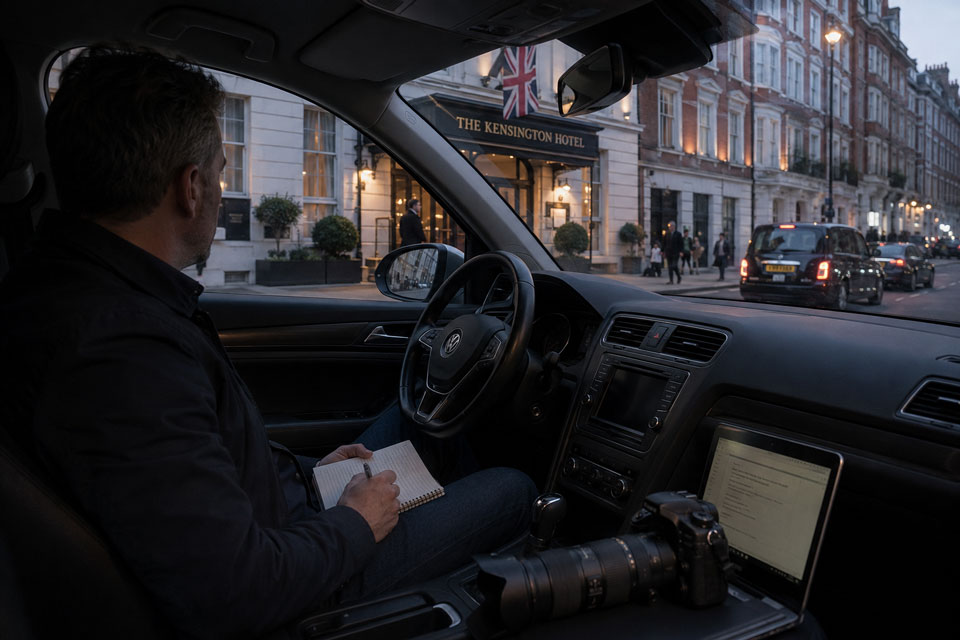
- Static or mobile surveillance where the circumstances justify it.
- Photographic or video evidence where it is necessary and proportionate.
- A written report of observations, timings and relevant activity.
- A detailed timeline of movements, meetings or events.
- Supporting open-source research where this is lawful and relevant.
People who instruct SPS Investigations for surveillance receive a full report, including photos and reports of the findings, along with a detailed timeline. This can help clients make informed decisions rather than relying on suspicion, rumour or confrontation.
What can a private investigator not legally do?
A professional investigator does not have police powers. We cannot break the law to obtain information, and neither can a client authorise us to do something unlawful on their behalf.
Private surveillance should not involve:
- Breaking into a property, trespassing or entering private premises without permission.
- Hacking phones, emails, social media accounts or computers.
- Installing spyware, malware or hidden access tools on a device.
- Intercepting calls, messages or private communications.
- Filming in private areas such as bedrooms, bathrooms, toilets or changing rooms.
- Harassing, threatening, confronting or intimidating the subject.
- Using surveillance for revenge, coercion, blackmail or stalking.
The Computer Misuse Act 1990 makes unauthorised access to computer material a criminal offence.[4] The Investigatory Powers Act 2016 also governs interception and related investigatory powers, which are not tools for ordinary private investigators.[5] In simple terms, a private investigator cannot hack someone’s phone, read their private messages, intercept calls or access an account without authority.
Surveillance, privacy and Article 8 rights
People in England have a right to respect for private and family life, home and correspondence under Article 8 of the Human Rights Act 1998.[6] This does not mean that every form of observation in a public place is unlawful. However, it does mean that privacy expectations matter.
There is a major difference between recording limited observations in a public setting and intruding into someone’s private home or personal life in a disproportionate way. The more private the location or information, the stronger the justification would need to be. The ICO’s guidance makes clear that areas where people have a heightened expectation of privacy, such as toilets and changing rooms, are extremely difficult to justify for surveillance purposes.[7]
This is why professional judgement matters. A compliant investigator should know when evidence can be gathered lawfully, when a method is too intrusive, and when a client’s request should be refused.
When can surveillance become harassment or stalking?
Surveillance becomes a serious legal risk when it turns into repeated, unwanted conduct that causes alarm, distress or fear. The Protection from Harassment Act 1997 prohibits a course of conduct that amounts to harassment, and the Act also includes stalking offences. Examples listed in the legislation include following a person and contacting or attempting to contact a person, depending on the circumstances.[8]
This is one of the biggest reasons to use a professional private investigation firm rather than attempting surveillance yourself. Emotionally charged situations, especially suspected infidelity, can escalate quickly. A trained investigator is detached, evidence-focused and aware of legal boundaries.
At SPS Investigations, we do not carry out surveillance designed to intimidate, punish or pressure someone. Our work is focused on discreet fact-finding where there is a legitimate and lawful basis.
Is workplace surveillance legal?
Workplace surveillance can be legal, but employers must be especially careful. Monitoring an employee can affect privacy, trust, employment rights and data protection obligations. The ICO has specific guidance on monitoring workers, which explains how employer monitoring interacts with UK GDPR and the Data Protection Act 2018.[9]
For businesses, surveillance is more likely to be appropriate where there is a specific concern, such as suspected theft, fraudulent sickness absence, serious misconduct, breach of contract, misuse of company property or working for another business while claiming to be unavailable. It should not be a fishing expedition.
Covert monitoring of workers is particularly sensitive. Employers should consider whether they have a clear reason, whether less intrusive options have been considered, whether the monitoring is limited in time and scope, and whether the evidence is genuinely needed. In many cases, a business should also take HR or legal advice before starting surveillance.
SPS Investigations can assist businesses where surveillance is legally appropriate. We can help gather evidence professionally and discreetly, while keeping the investigation targeted and proportionate.
Do you need the subject’s consent?
Not always. Covert surveillance, by its nature, usually means the person being observed is not told in advance. However, the absence of consent does not remove the need for a lawful basis, a legitimate purpose and fair handling of personal data.
In many surveillance scenarios, consent is not realistic because telling the subject would undermine the investigation. The ICO notes that for video surveillance in public spaces it is often difficult to obtain genuine consent, so organisations usually need to identify another lawful basis, such as legitimate interests, where appropriate.[10]
This is another reason why surveillance should be planned properly. A professional investigator should not collect more information than necessary, should store it securely, and should avoid retaining it for longer than needed.
Can surveillance evidence be used in court or a dispute?
Surveillance evidence can be useful, but how it is used depends on the situation. It may support a civil dispute, employment investigation, family matter, insurance issue, internal disciplinary process or solicitor-led case. However, the way evidence is gathered matters. Evidence obtained unlawfully, unfairly or disproportionately may be challenged and could create legal problems for the client.
A professional surveillance report should be factual, dated, timed and clearly structured. It should separate observation from opinion. At SPS Investigations, our surveillance work is documented through a full report, photos where appropriate, and a detailed timeline of the findings. This helps clients, solicitors or businesses understand exactly what was observed and when.
If you intend to use surveillance evidence in legal proceedings, you should take advice from a qualified solicitor on disclosure, admissibility and case strategy.
How SPS Investigations keeps surveillance compliant
SPS Investigations provides discreet private surveillance services across London and the Home Counties. We have helped many individuals and businesses uncover the truth over recent years, including suspected infidelity matters and business-related investigations.
Our compliance-first approach includes:
- Understanding the client’s reason for surveillance before accepting instructions.
- Refusing work that appears unlawful, malicious, oppressive or disproportionate.
- Keeping surveillance focused on the issue being investigated.
- Using lawful observation methods only.
- Handling evidence confidentially and securely.
- Providing a clear report, photographs where appropriate, and a detailed timeline.
Surveillance is most effective when it is calm, planned and professional. It should not be dramatic, confrontational or reckless. In many cases, using an experienced private investigator saves time, reduces risk and helps the client avoid making decisions based only on suspicion.
When should you consider private surveillance?
You may wish to consider private surveillance if you have a genuine concern that needs evidence rather than guesswork. This could include a spouse or partner whose behaviour suggests possible infidelity, an employee suspected of serious misconduct, or a business situation where facts need to be established discreetly.
However, surveillance is not always the right first step. Sometimes, background checks, open-source research, people tracing, process serving or advice from a solicitor may be more suitable. A reputable investigator should be honest about this.
If you are unsure whether surveillance is appropriate, contact SPS Investigations. We can discuss your situation confidentially and explain whether surveillance is likely to be lawful, proportionate and useful.
FAQ’s
Is it legal to hire a private investigator for surveillance in England?
Yes, it can be legal to hire a private investigator for surveillance in England, provided there is a legitimate purpose and the methods used are lawful, necessary and proportionate. A private investigator cannot trespass, hack accounts, intercept communications or harass the subject.
Can a private investigator follow someone?
A private investigator may be able to observe or follow someone in public as part of a lawful and proportionate investigation. However, repeated or intrusive conduct without proper justification may create harassment or stalking risks.
Can a private investigator take photos or video?
Yes, photos or video may be taken where it is lawful and proportionate, usually from public places or other lawful locations. Recording in private areas, or capturing more information than necessary, can be unlawful or non-compliant.
Can surveillance be used to catch a cheating partner?
Surveillance may be appropriate where someone has genuine concerns about infidelity and needs facts before making important personal decisions. SPS Investigations can carry out discreet surveillance where legally appropriate and provide a report, photos where relevant, and a detailed timeline.
Can an employer use a private investigator to monitor an employee?
Yes, but employers must be careful. Employee surveillance should be based on a specific concern, such as suspected serious misconduct or fraud, and must comply with data protection and employment law principles. Covert workplace monitoring should be targeted, justified and limited.
Is it legal to put a tracker on someone’s car?
This is legally sensitive and depends on ownership, authority, purpose and data protection issues. Attaching a tracker to a vehicle without clear lawful authority can create serious legal risks. SPS Investigations will not use tracking methods unless there is a clear lawful basis.
Can a private investigator access someone’s phone or WhatsApp messages?
No. A private investigator cannot hack a phone, access private accounts, intercept WhatsApp messages, read emails without authority or install spyware. These methods may breach criminal and data protection laws.
Will the person know they are under surveillance?
In many private investigations, surveillance is covert, meaning the subject is not told in advance. That does not remove the need for lawful purpose, proportionality and secure handling of personal data.
What do I receive after a surveillance investigation?
People who use SPS Investigations’ surveillance service receive a full report, with photos and reports of the findings where appropriate, along with a detailed timeline. The aim is to provide clear, factual evidence rather than speculation.
How do I know if surveillance is right for my case?
The best first step is to speak confidentially with a professional investigator. SPS Investigations can assess the situation, explain what may be lawful and proportionate, and advise whether surveillance is the right approach.
References
1) Information Commissioner’s Office – Video surveillance guidance, including CCTV:
https://ico.org.uk/for-organisations/uk-gdpr-guidance-and-resources/cctv-and-video-surveillance/guidance-on-video-surveillance-including-cctv/
2) GOV.UK – The UK’s data protection legislation:
https://www.gov.uk/data-protection
3) GOV.UK – Data Use and Access Act 2025: plans for commencement:
https://www.gov.uk/guidance/data-use-and-access-act-2025-plans-for-commencement
4) Legislation.gov.uk – Computer Misuse Act 1990:
https://www.legislation.gov.uk/ukpga/1990/18/contents
5) Legislation.gov.uk – Investigatory Powers Act 2016:
https://www.legislation.gov.uk/ukpga/2016/25/contents
6) Legislation.gov.uk – Human Rights Act 1998, Article 8:
https://www.legislation.gov.uk/ukpga/1998/42/schedule/1/part/I/chapter/7
7) Information Commissioner’s Office – How to comply with data protection principles when using surveillance systems:
https://ico.org.uk/for-organisations/uk-gdpr-guidance-and-resources/cctv-and-video-surveillance/guidance-on-video-surveillance-including-cctv/how-can-we-comply-with-the-data-protection-principles-when-using-surveillance-systems/
8) Legislation.gov.uk – Protection from Harassment Act 1997:
https://www.legislation.gov.uk/ukpga/1997/40/contents
9) Information Commissioner’s Office – Employment practices and data protection: monitoring workers:
https://ico.org.uk/for-organisations/uk-gdpr-guidance-and-resources/employment/monitoring-workers/
10) Information Commissioner’s Office – UK GDPR Code of Conduct for Investigative & Litigation Support Services:
https://ico.org.uk/for-organisations/advice-and-services/codes-of-conduct/register-of-uk-gdpr-codes-of-conduct/the-association-of-british-investigators-limited-uk-gdpr-code-of-conduct-for-investigative-litigation-support-services/
Need Private Surveillance?
We carry out professional surveillance across London & The Home Counties.
Get in touch